Iris
A facilitator for group decisions.
"Design an AI agent that serves a whole room instead of a single user — one that sits inside a live group conversation, holds everyone's interests at once, and helps them reach a decision the group actually owns, without deciding for them. Walk us through the rationale, and show a working prototype."
The oldest form of intelligence is social.

presentation/assets/zendaya-athena.webpTo end a cycle of blood-vengeance, Aeschylus didn't reach for a warrior or a king — he reached for Athena, goddess of wisdom. In the Oresteia (458 BCE) she convenes the first trial, replaces private revenge with reasoned judgment, and wins over even the losing side (the vengeful Furies become the Eumenides).
Helping people resolve conflict and reach agreement is a deep form of intelligence — the ancients counted it among the highest. For millennia that wisdom was uniquely human. A model with deep social intelligence is the first non-human that could practice it.
Aeschylus, Eumenides (the Oresteia), 458 BCE. Image: Zendaya as Athena in Christopher Nolan's The Odyssey (2026) — © Universal Pictures, used for illustration.
Facilitation is a structured practice.
The role is ancient; the profession is young. Over the last ~80 years it's been formalized into a real practice — a neutral process-holder with named, teachable techniques.
Kurt Lewin · MIT & NTL
Founded group dynamics & the T-group.
To rebuild democratic groups and ease intergroup conflict after WWII.
Mediation & the caucus · labor & community mediators
Codified in Moore's Mediation Process: a private caucus surfaces what won't be said at the table.
To settle disputes without the courts — and without wrecking the relationship.
Getting to Yes · Fisher & Ury, Harvard Negotiation Project
Principled negotiation: interests, not positions.
A fix for win-lose positional bargaining.
Kaner's Diamond · Sam Kaner, Community At Work
Groups pass through the "groan zone" to reach real buy-in.
Genuine consensus over false or imposed agreement.
Lewin & NTL, T-groups (1947); Christopher Moore, The Mediation Process (1986); Fisher & Ury, Getting to Yes, Harvard Negotiation Project (1981); Sam Kaner et al., Facilitator's Guide to Participatory Decision-Making, Community At Work (1996).
A human facilitator hits four hard limits.
Iris is a facilitator that lives inside a group's chat.
It reads the room, holds a private 1:1 with each person, and brokers a decision everyone endorses.
The four components that make Iris a well-designed agent.
Two ideas Iris is built on.
The caucus is a private conversation a facilitator has with each participant. It surfaces the preferences people won't say publicly — which Iris folds into its public suggestions.
→ Iris's private sidebar
Theory of mind. Iris keeps a private model of each participant's mind — grounded in belief–desire–intention. For each person she tracks the interest under their position (desire), what they're advocating (stance), what they assume (beliefs), and how they regard the others — updated as everyone speaks.
→ Iris's sealed model of each person
Caucus — a core mediation technique (ABA; Beyond Intractability). Theory of mind — belief–desire–intention (Bratman 1987; Rao & Georgeff 1995); interests vs. positions (Fisher & Ury, Getting to Yes, 1981).
Where it lives on WhatsApp (consumer)
How does Iris surface her thoughts?
One private line, or a note on every message?
Where it lives on Slack (enterprise)
Where does the private caucus live?
Should Iris track everything, or ask first?
The SDK is a third surface — for developers.
Iris is a product and a substrate. The same multi-principal engine behind the consumer app and the enterprise bot ships as a developer SDK: embed Iris in your own product, bring your own UI, and build any collaboration agent on its primitives.
Three surfaces, one engine
Consumer — WhatsApp, for friend groups & plans.
Enterprise — Slack, for teams putting decisions on the record.
Developer — the SDK: embed Iris, bring your own UI, build any collaboration agent.
→ the collaboration engine, exposed
~250 LOC · zero deps · bring your own model
const iris = new IrisAgent({
participants, // the group
policy, // how it thinks (facilitator/coach)
surface, // co-owned artifact (decisions|poll|…)
model, // any ({system,prompt})=>string
});
await iris.run({ type:'message', author, text });
Sealed per-person memory, the de-identified Canvas, and the caucus loop come built in — swap the surface + policy and the same class is a standup bot or a vote.
Iris facilitates — it does not decide.
A decision Iris handed down would be complied with, not owned — and the moment circumstances shift, it unravels. Facilitation isn't the polite option; it's the mechanism that makes a decision both better and durable. Two separate bodies of research say why.
Better — the group knows more than the room says
Groups rehash what everyone already shares and fail to surface what only one person knows. In "hidden-profile" studies, groups are ~8× less likely to reach the right answer than if all facts were pooled (Stasser & Titus, 1985). Drawing out private information and dissent is what raises quality — precisely the caucus's job.
Durable — a fair process is internalized, not enforced
Given real voice in a process they trust, people accept and implement an outcome as their own — even an unfavorable one — so compliance is self-regulatory (procedural justice; Tyler & Lind). The evidence is longitudinal: at 12-year follow-up, mediated agreements show higher compliance and cooperation than litigated ones (Emery).
So Iris's job is to run the fair process — surface what's unsaid, give everyone voice, broker an option the group can own.
How Iris acts — triggers & data flow
The agent harness puts its policy to work
Iris keeps a theory of mind of each person.
For every participant, Iris builds an evolving, sealed model of their mind — grounded in belief–desire–intention — revised each time they speak. It never leaves memory; only de-identified constraints reach the room. And she keeps her read of them separate from her plan for them.
Three layers — only the first is their mind
Theory of mind — my read of their mind:
interest (desire) · position (stance) · beliefs (what they assume) · arc (disposition) · regards (how they see the others)
My confidence — how sure I am (hunch → confirmed). Mine, not a fact about them.
My plan — what I'm watching for + how I can help next. My agency, not their mind.
→ built from scratch, revised as they speak
position: keeps floating a cheaper week
beliefs: assumes the others can all afford the villa
arc: quiet
regards → Priya: "worried she'll lock the villa first"
help next: caucus for the number, then surface it de-identified
Theory of mind — belief–desire–intention (Bratman 1987; Rao & Georgeff 1995); interests vs. positions (Fisher & Ury, 1981). Evolving per-peer models inspired by Honcho, Letta, and Generative Agents.
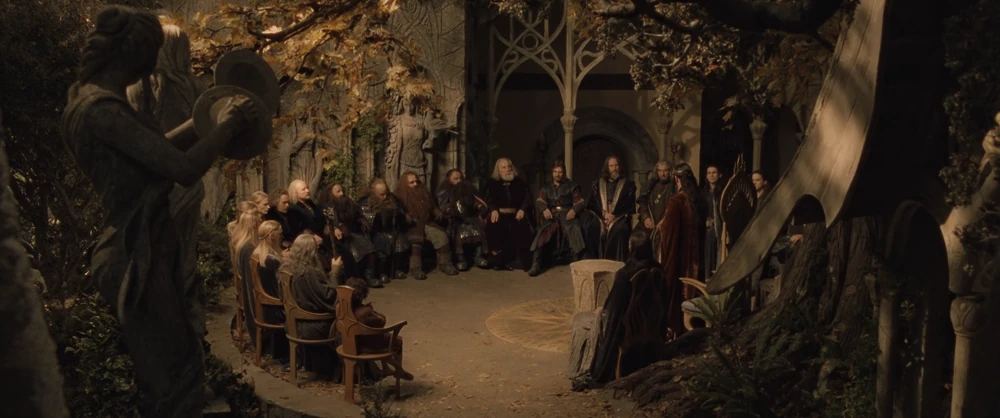
The mythic cross-team decision.
Elves, dwarves, men — ancient grudges, loud voices, and one small overlooked voice (Frodo). The Council reaches the right answer, but only by luck and exhaustion.
presentation/assets/council-of-elrond.webpStanding on real work.
- Heron's Six Categories of Intervention — John Heron (1975), Human Potential Research Project, University of Surrey. Iris's facilitator↔coach range and non-directive language norms follow the facilitative side of this model.
- Facilitation practice — Kaner et al., Facilitator's Guide to Participatory Decision-Making (the Diamond / Groan Zone); Fisher & Ury, Getting to Yes (interests, not positions); the mediation caucus; Rosenberg, NVC.
- Agent memory & context engineering — Anthropic memory tool; Letta / MemGPT memory blocks & sleep-time compute; Honcho per-peer representations & dialectic; OpenClaw SOUL / HEARTBEAT; Park et al., Generative Agents (reflection).
- Why groups fail — Kuran, preference falsification; Harvey, the Abilene paradox; Janis, groupthink.
- Why facilitation is better & more durable — Stasser & Titus (1985), hidden profiles / information pooling; Tyler & Lind, procedural justice; Coch & French (1948) and Vroom-Yetton, participation → commitment; Emery, divorce-mediation durability (12-year follow-up).
- Social prominence of a group AI — Johnson, Nebeling, et al., "Interface-Driven Social Prominence…", CHI 2026.